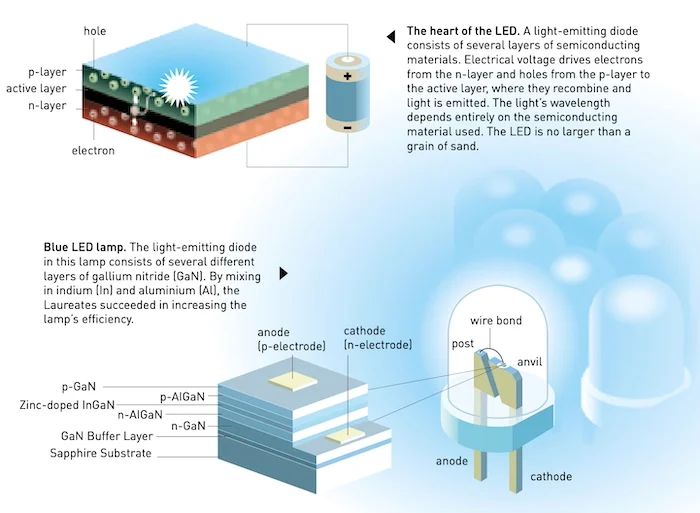
Nobel prize winner Isamu Akasaki invented efficient blue light-emitting diodes, enabling bright, energy-efficient white light sources.
Isamu Akasaki’s pioneering work on gallium nitride (GaN) led to the development of efficient blue LEDs, subsequently transforming lighting technology and illuminating applications we all use today. His innovations in crystal growth, doping techniques, and p-n junction formation have had a lasting impact on industries ranging from energy-efficient lighting to power electronics and 5G communications.

GaN Growth Pains
Born in 1929 in Chiran, Japan, Akasaki’s career took off after he earned his doctorate in engineering from Nagoya University in 1964. While his early research focused on materials like germanium crystals, Akasaki began experimenting with semiconductor materials, particularly those capable of emitting blue light, in the late 1960s.
This work eventually led him to focus on GaN, a material that, at the time, was challenging to work with due to its robust material properties, like its high melting point. This makes it difficult to grow GaN on standard substrates like silicon. The crystal growth issues were compounded by the fact that GaN has a very different lattice structure than common substrates like sapphire. Akasaki experimented with several techniques for growing the material, including molecular-beam epitaxy (MBE) and metal-organic vapor-phase epitaxy (MOVPE).
In 1985, Akasaki and his team experimented with a thin layer of aluminum nitride (AlN) used as a buffer between a sapphire substrate and GaN. This allowed the GaN to grow uniformly, overcoming the lattice mismatch problem and dramatically increasing the crystal quality.
Another breakthrough came in 1989 when Akasaki, alongside Hiroshi Amano, successfully demonstrated p-type GaN. P-type semiconductors are essential for creating p-n junctions, which are the fundamental components of LEDs. Akasaki and Amano’s work involved doping GaN with magnesium—a common method for creating p-type materials—and using electron beam irradiation to activate the magnesium and make the p-type GaN conductive.
GaN-Based Blue LEDs
Akasaki, along with Professors Hiroshi Amano and Shuji Nakamura, leveraged these works on crystal quality and p-type GaN to fabricate the first GaN-based blue LEDs in the early 1990s.
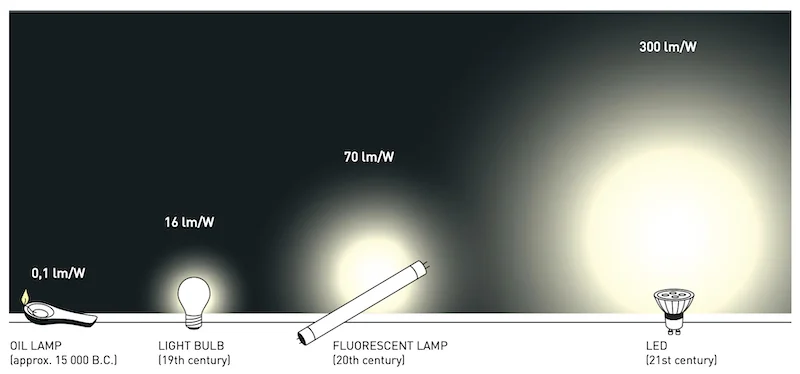
This was a landmark achievement that led to the combination of blue light with existing red and green LEDs to enable a whole new generation of bright, energy-efficient white LED lighting. Akasaki’s findings revolutionized the lighting industry by offering an energy-efficient and long-lasting alternative to traditional incandescent and fluorescent bulbs. Blue LEDs became integral in various applications, including high-definition displays, optical storage (like Blu-ray), and even medical devices.
GaN-based blue LEDs also opened up opportunities in other areas of optoelectronics, including ultraviolet (UV) LEDs. GaN’s wide bandgap also made it a useful material for UV light emission, leading to devices for sterilization, water purification, and beyond.
Applications Beyond Lighting
Akasaki’s work didn’t just lead to the creation of blue LEDs; it had a major impact on the entire lighting industry and showcased the utility of GaN as a wide-bandgap semiconductor. While it wasn’t widely used when Akasaki began his research, GaN is now critical for manifold power applications, from electric vehicles to renewable energy infrastructure. GaN is also essential in many high-frequency devices, including components for 5G communication systems.
Akasaki’s research is viewed by many as foundational to the adoption of GaN, certain device fabrication techniques, and the evolution of optoelectronic technologies. Akasaki was awarded the Nobel Prize in Physics in 2014, along with the Kyoto Prize in Advanced Technology (2009) and the IEEE Edison Medal (2011), among others.
He died in 2021 at the age of 92.